
Structured Data & Schema:
How to Help Machines Understand Your Content

Structured data adds explicit context to your website so search engines and other systems can better understand what your content represents.

Good Content Still Needs Context

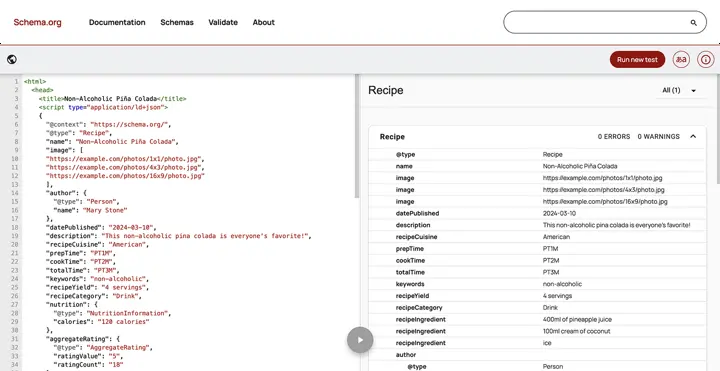
Schema Markup Validator from Schema.org

People are pretty good at inference. We can look at a page and usually figure out whether we're reading an article, looking at a product, reviewing a restaurant, or learning about a business.

Machines need a little more help. Structured data provides explicit information about the people, organizations, products, places, events, articles, and other entities described on a page. Most modern implementations use JSON-LD, a machine-readable format that sits alongside the visible content of a webpage.

Structured data doesn't replace good content. It doesn't create authority. And it isn't a secret shortcut to AI visibility. What it does is make meaning more explicit. That matters.

What Is Structured Data?

Structured data is information added to a webpage in a standardized format that helps machines interpret what the page contains.

For example, a visitor may see:

Digital Rebel Media
Nocona, Texas
Publisher

Structured data can explicitly identify that information as an organization, give it a name, location, URL, logo, and relationships to other entities.

The vocabulary most websites use comes from Schema.org.

Think of it as adding labels to information your website already contains.

Not:

“Here are some words on a page.”

But:

“This is an organization.”
“This person wrote this article.”
“This is an event.”
“This is the address of this local business.”

That additional context can help search engines and other systems interpret your content more consistently.


Common Types of Schema Markup

You don't need every schema type available.

You need the types that accurately describe the information actually present on your site.

Other schema types may be appropriate depending on the website, but the principle remains the same:

Use structured data to describe reality, not to manufacture it.

Organization

Useful for identifying a company, publisher, nonprofit, or other organization.

Typical properties may include:

  • Name
  • URL
  • Logo
  • Contact information
  • Social profiles
  • Parent or related organizations

LocalBusiness

Useful for businesses serving a physical location or geographic market.

It can describe information such as:

  • Business name
  • Address
  • Phone number
  • Hours
  • Geographic coordinates
  • Service area
  • Business category

For local businesses, this information should agree with what appears elsewhere on the website and across important business profiles.

Article

Helps identify editorial content and its relationship to authors and publishers.

Typical information includes:

  • Headline
  • Author
  • Publisher
  • Publication date
  • Modified date
  • Featured image

For a publication like Digital Rebel Media, this relationship between article → author → publisher is particularly important for creating a clear content structure.

Product

Can describe information about products, including names, descriptions, brands, offers, and other relevant properties when appropriate.

Event

Useful for conferences, webinars, workshops, performances, and other scheduled events.

Person

Can identify authors, executives, experts, speakers, and other people discussed or represented on a website.

BreadcrumbList

Describes the hierarchy of a page within a website and reinforces how content is organized.

Schema Is Not a Ranking Cheat Code

This is where structured data gets oversold.

Adding JSON-LD does not automatically make weak content useful.

  • It does not turn an unknown company into an authority.
  • It does not guarantee a rich result.
  • It does not guarantee that an AI system will cite or recommend your website.

Structured data works best as part of a larger information system.

  • The visible content says something.
  • The page structure organizes it.
  • Internal links establish relationships.
  • Author and organization information establish context.
  • Third-party references provide outside evidence.

Structured data helps make those relationships more explicit.

That's useful. It's just not magic.

Why Structured Data Matters for Search

Search engines have to interpret billions of pages written in wildly different formats.

Structured data gives them standardized information they can process more easily. That can help clarify:

What something is.
Is this a business, article, product, person, place, or event?

Who it belongs to.
Who wrote the article? Who published it? Which organization operates this website?

How information relates.
Is this person the author? Is this organization the publisher? Is this location associated with the business?

Which facts are explicit.
What are the opening hours? When was the article published? What is the official business name?

This becomes especially useful on large or complex sites where relationships between content aren't always obvious from one page alone.

What About AI Search?

This is where the conversation gets more interesting.

AI-powered discovery adds another reason to think carefully about machine-readable information, but businesses should avoid treating schema as an “AI optimization button.”

AI systems can use many kinds of information when understanding the web. Structured data is one way to make facts and relationships explicit.

For example, a website can clearly establish:

This is the business.
This is its location.
This person is an expert associated with it.
This article was written by that person.
This organization published the article.

That type of clarity supports the broader goal of AEO: making information easier to discover, interpret, and evaluate. The important word is supports.

Schema strengthens context. It doesn't replace the context.

Structured Data Should Match the Page

One of the easiest schema mistakes is marking up information that isn't actually represented on the page.

If the page is an article, describe the article. If the page represents a local business, describe the business.

If it contains an event, mark up the event. Don't add schema simply because a markup type sounds useful.

The machine-readable version of the page should accurately reflect the human-readable version.

A good rule:

If the structured data tells a substantially different story than the page itself, something is wrong.

Ironically, that's exactly why schema deserves more attention than simply installing a plugin and forgetting about it.

Implementation: Template-Level Beats Page-by-Page

On most modern websites, structured data should be part of the content system rather than something manually pasted into individual pages.

  • Article templates can generate Article markup.
  • Author profiles can generate Person markup.
  • Location pages can generate LocalBusiness information.
  • Event entries can generate Event markup.
  • Products can generate Product information.

That creates two advantages.

First, the data stays connected to the content being managed in the CMS.

Second, updates don't require someone to remember that there's a random blob of JSON hiding in the source code.

That becomes increasingly important as a site grows.

Validate It. Then Maintain It.

Structured data shouldn't be treated as “install once and walk away.”

  • Sites change.
  • Templates change.
  • Fields get renamed.
  • Pages get removed.
  • Plugins get updated.
  • Somebody redesigns the website and accidentally deletes half the markup because Tuesday needed more excitement.

Periodically check for:

  • Invalid markup
  • Missing required or recommended properties
  • Incorrect entity relationships
  • Duplicate entities
  • Outdated business information
  • Schema that no longer matches visible content
  • Markup generated by plugins that conflicts with custom markup

Validation is technical housekeeping. The more important question is whether the structured data still accurately describes the site.

Who Should Care About Structured Data?

Structured data can be useful for almost any organization publishing information online, but it becomes especially valuable when a website contains multiple entities or content types.

  • Local businesses can clarify locations, contact information, hours, and organizational details.
  • Publishers can strengthen relationships between articles, authors, and the publishing organization.
  • Ecommerce businesses can describe products and offers more explicitly.
  • B2B companies can clarify organizations, people, content, services, and other important entities.
  • Event-driven organizations can structure information about webinars, conferences, workshops, and scheduled activities.
  • Large content sites benefit from consistent machine-readable relationships across thousands of pages.

The question isn't:

“Do we need schema?”

A better question is:

“Which information on this site deserves to be represented more explicitly?”

A Practical Structured Data Checklist

Start simple.

  1. Identify the major entities on your site: organization, people, locations, articles, products, events, and other important objects.
  2. Match those entities to appropriate Schema.org types.
  3. Make sure the visible page content supports what you're marking up.
  4. Generate structured data from your CMS whenever possible instead of maintaining it manually.
  5. Connect related entities such as authors, organizations, locations, and articles.
  6. Validate the output and fix technical errors.
  7. Recheck structured data after redesigns, CMS changes, migrations, or major content updates.
  8. Treat schema as part of the site's information architecture—not a standalone SEO trick.

Structured Data Works Best as Part of the System

Structured data doesn't work in isolation.

It connects to:

  • Technical SEO because search engines still need to crawl and process the page.
  • Content strategy because markup can't rescue information that isn't useful.
  • AEO because clear entities and relationships help machines interpret information.
  • Local SEO because accurate business information matters across multiple platforms.
  • Authority because describing yourself clearly is different from proving that others trust you.

That distinction matters.

Structured data tells machines:

“This is who we say we are.”

The wider web helps establish:

“And here's the evidence.”

You need both.

Digital Marketing Insights & Tactics

Ai search battle plan

AI Search Battle Plan

Your SEO isn’t dead; it just needs a tactical upgrade. Learn how to dominate the SERP with a proactive AI search strategy.

Growth requires strategy

Growth Requires Strategy

If you want to grow beyond your market, DIY marketing will not get you there.

Diy marketing trap

The Hidden Costs of DIY Marketing

DIY marketing can cost more than it saves. Learn how guesswork, wasted time, and missed opportunities hurt your business growth.

Website collecting dust bg

Stop Letting Your Website Collect Dust

Why your website should be more than just an online brochure. Learn how SEO & AEO can turn it into a powerful growth tool.

Mastering ai search hero

AI Search: Optimize Both Organic & PPC

AI-powered search is reshaping organic and PPC strategies. Learn how to optimize your entire digital presence to dominate AI-driven search results.