

Why Your Website Traffic Suddenly Looks Like It’s From Singapore

Chris Martin
Founder, Digital Rebel Marketing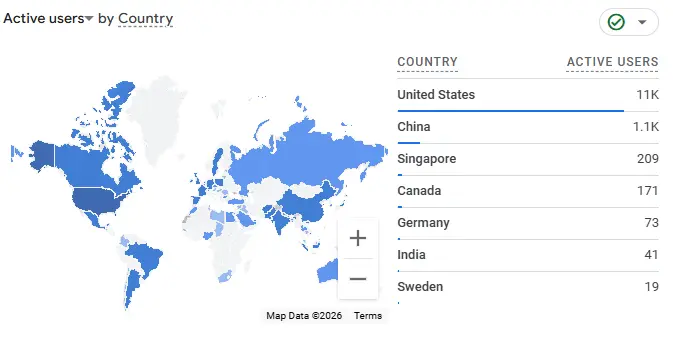
Open your analytics lately and noticed something weird?
- Traffic from Singapore.
- China.
- Eastern Europe.
Countries where you don’t sell, don’t market, and definitely don’t have customers.
Congratulations. You’ve discovered the new side effect of the AI search era.
And no, it’s not your international expansion strategy finally kicking in.
It’s AI crawlers.
The AI Scraping Boom Is Warping Your Analytics

AI models, data brokers, and content aggregators are aggressively crawling websites to ingest content for training, retrieval systems, and answer engines.
The problem? Many of those crawlers originate from data centers located outside the U.S., often in places like:
- Singapore
- China
- Hong Kong
- Eastern Europe
- South America
From your analytics platform’s perspective, this looks like legitimate traffic.
But it’s not buyers.
It’s not prospects.
It’s not pipeline.
It’s machines vacuuming up your content.
And it’s quietly destroying the accuracy of your engagement metrics.
What Gets Skewed

When these bots hit your site, they can distort key marketing signals:
- Traffic numbers spike artificially
- Session durations become meaningless
- Bounce rates fluctuate
- Conversion ratios drop
- Engagement signals weaken
Now your dashboard tells a story that simply isn’t true.
And when leadership reviews performance, marketing suddenly looks less effective than it actually is.
The Real Risk: Bad Data Leads to Bad Decisions
In modern marketing, your analytics stack drives strategy.
If your traffic data is polluted by AI crawlers, your team starts making decisions based on fiction.
You might:
- Kill content that actually converts
- Double down on pages that attract bots
- Misinterpret engagement trends
- Misjudge campaign performance
For companies investing serious money in content and SEO, that’s a dangerous blind spot.
Especially when your website is supposed to be a conversion engine, not a public data buffet.
A Practical Fix: Country Whitelisting or Blacklisting
One of the simplest ways to clean up your analytics is geo-level filtering at the infrastructure layer.
In plain English:
If you don’t do business in a country, there’s a strong argument that their traffic shouldn’t reach your site.
Two common approaches exist.
Option 1: Country Whitelisting
This is the strict approach.
You allow traffic only from countries where you actually operate.
Example:
- United States
- Canada
- United Kingdom
- Australia
Everything else gets blocked at the firewall or CDN level.
Pros
- Cleaner analytics data
- Reduced bot scraping
- Less server load
- Stronger security posture
Cons
- Could block legitimate researchers or partners
- Requires careful monitoring
Option 2: Country Blacklisting
This approach blocks high-risk or high-bot regions while leaving most traffic open.
Common blacklist candidates:
- China
- Russia
- Certain proxy-heavy hosting regions
Pros
- Easier to implement
- Lower risk of blocking real prospects
- Reduces the majority of scraping noise
Cons
- Bots can still route through other countries
- Analytics will still contain some noise
Where This Filtering Should Happen

The most effective place to implement geo controls is before traffic hits your application layer.
That typically means:
- CDN firewall rules
- Hosting-level geo restrictions
- Web application firewalls
- Reverse proxy filtering
This keeps bad traffic from ever touching your site.
This Is the New Reality of the AI Search Era
AI-driven search has changed the game.
Your website is now being crawled not just by Google, but by:
- LLM training systems
- AI answer engines
- Data aggregators
- Competitive intelligence tools
Which means your analytics platform is no longer just measuring humans.
It’s measuring machines pretending to be humans.
If you care about real performance data, you need to start treating analytics like a data integrity problem, not just a reporting tool.
The Bottom Line

More traffic does not equal more growth.
Clean data equals better decisions.
If your dashboards are filled with traffic from countries where you don’t sell, don’t advertise, and don’t ship products…
That’s not demand.
That’s scraping.
And sometimes the smartest move isn’t chasing more visitors.
It’s closing the door on the ones that were never buyers in the first place.
Stop Letting Bots Pollute Your Marketing Data
If you want cleaner analytics, stronger security, and a website built to perform in modern search, let’s talk.